
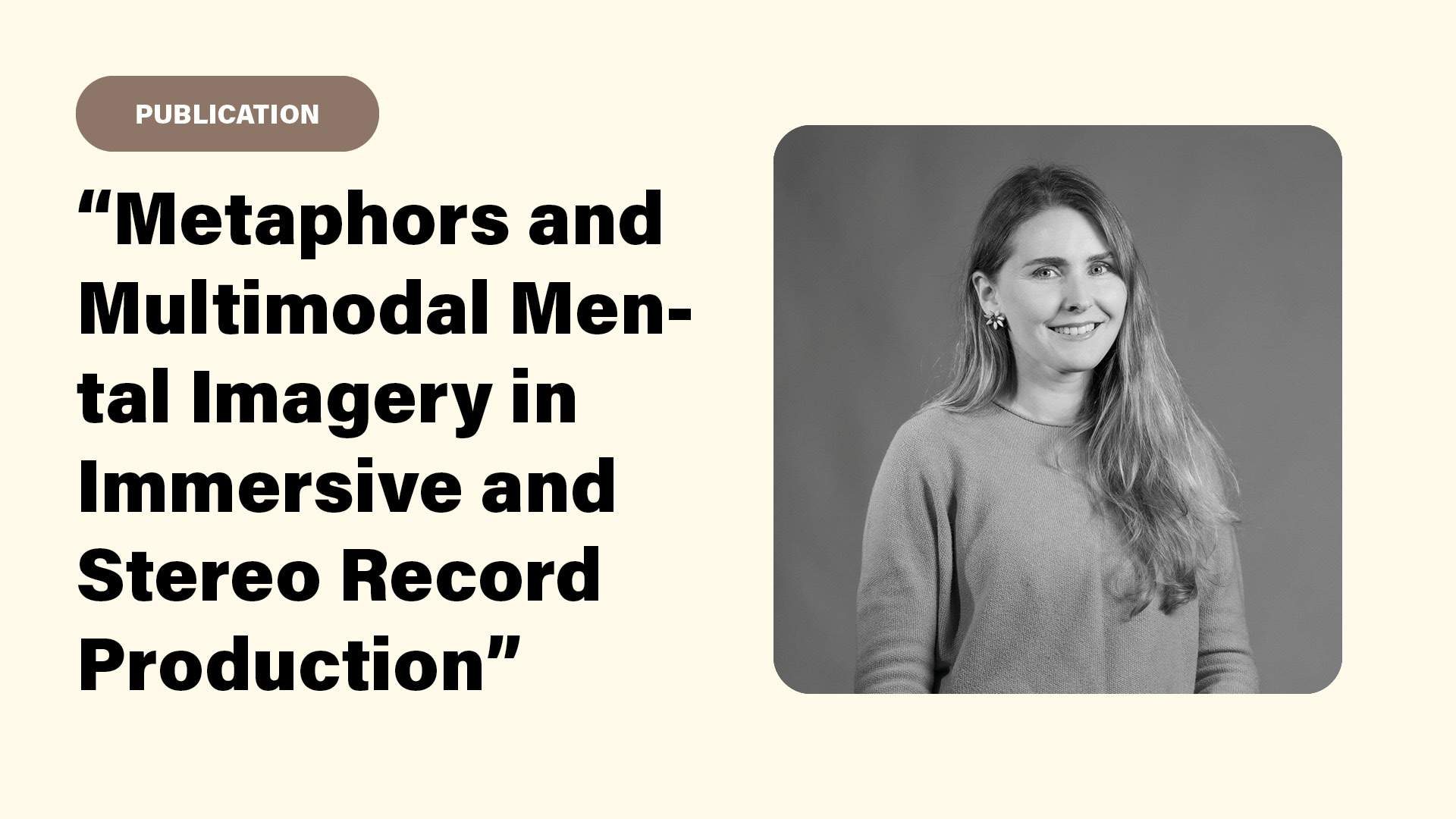
Publication “Metaphors and Multimodal Mental Imagery in Immersive and Stereo Record Production” Ingvild Koksvik

New Publication: Metaphors and Multimodal Mental Imagery in Immersive and Stereo Record Production

The inaugural issue of Journal of Music Production Research, published on 29 October 2025, features six articles – one of which is written by CreaTeME researcher Ingvild Koksvik. 


In her article ‘Metaphors and multimodal mental imagery in immersive and stereo record production’  Koksvik examines how embodied metaphors and mental imagery inform artistic and technical decisions in the recording and mixing process. Drawing on the production of the track ‘Noen ganger’, she demonstrates how metaphorical language can bridge abstract creative intentions and technical execution, particularly within immersive audio formats such as Dolby Atmos.

Author:
Ingvild Koksvik
Abstract:
This article explores how the use of metaphors and multimodal mental imagery opens diverse creative pathways in the collaborative process of record production. The dual functionality of metaphors in record production informs this function. On the one hand, they are sound descriptors; on the other hand, they are tools for verbally articulating the experiential facets of multimodal mental imagery. The article addresses a practice-based study of the recording and mixing of the song ‘Noen ganger’, mixed for playback in Dolby Atmos and stereo. It demonstrates how a single articulated metaphor triggered several artistic consequences via a creative loop of imagery, metaphors, sound production, and processing, leading to the recording’s final soundscape and aesthetic output. The article argues that metaphors may bridge the gap between the abstract and the concrete, helping us to both understand and interpret elusive artistic ideas involving mental imagery and transition those ideas into recordings. It also explores how methods such as log writing can bring otherwise tacit aspects of mental imagery and metaphorical understandings out into the open.

About the author:

Ingvild Koksvik is a singer and song-maker whose music career spans several albums of original music, commissioned works for festivals and extensive touring as a live artist across Norway and Europe. She is currently a Ph.D. candidate in popular music performance at the University of Agder, where she also has worked as a researcher at CreaTeME. Her Ph.D. explores the elusive and often tacit dimensions of musical ideas and intentions, and how these influence aesthetic, compositional and performative aspects of record production. She holds a master’s degree in musicology from the University of Oslo, where she also worked as a research assistant for two years.

About the journal: 

The Journal of Music Production Research (JMPR) is a peer-reviewed academic publication that aims to define, analyze and advance scholarly discourse in the diverse field of music production. It emphasizes the artistic, technical and innovative practices that shape this discipline, serving as a leading platform for rigorous research and critical inquiry where art, science and industry practice intersect.’

The inaugural issue of Journal of Music Production Research, published on 29 October 2025, features six articles – one of which is written by CreaTeME researcher Ingvild Koksvik. 


In her article ‘Metaphors and multimodal mental imagery in immersive and stereo record production’  Koksvik examines how embodied metaphors and mental imagery inform artistic and technical decisions in the recording and mixing process. Drawing on the production of the track ‘Noen ganger’, she demonstrates how metaphorical language can bridge abstract creative intentions and technical execution, particularly within immersive audio formats such as Dolby Atmos.

Author:
Ingvild Koksvik
Abstract:
This article explores how the use of metaphors and multimodal mental imagery opens diverse creative pathways in the collaborative process of record production. The dual functionality of metaphors in record production informs this function. On the one hand, they are sound descriptors; on the other hand, they are tools for verbally articulating the experiential facets of multimodal mental imagery. The article addresses a practice-based study of the recording and mixing of the song ‘Noen ganger’, mixed for playback in Dolby Atmos and stereo. It demonstrates how a single articulated metaphor triggered several artistic consequences via a creative loop of imagery, metaphors, sound production, and processing, leading to the recording’s final soundscape and aesthetic output. The article argues that metaphors may bridge the gap between the abstract and the concrete, helping us to both understand and interpret elusive artistic ideas involving mental imagery and transition those ideas into recordings. It also explores how methods such as log writing can bring otherwise tacit aspects of mental imagery and metaphorical understandings out into the open.

About the author:

Ingvild Koksvik is a singer and song-maker whose music career spans several albums of original music, commissioned works for festivals and extensive touring as a live artist across Norway and Europe. She is currently a Ph.D. candidate in popular music performance at the University of Agder, where she also has worked as a researcher at CreaTeME. Her Ph.D. explores the elusive and often tacit dimensions of musical ideas and intentions, and how these influence aesthetic, compositional and performative aspects of record production. She holds a master’s degree in musicology from the University of Oslo, where she also worked as a research assistant for two years.

About the journal: 

The Journal of Music Production Research (JMPR) is a peer-reviewed academic publication that aims to define, analyze and advance scholarly discourse in the diverse field of music production. It emphasizes the artistic, technical and innovative practices that shape this discipline, serving as a leading platform for rigorous research and critical inquiry where art, science and industry practice intersect.’

Table of Contents

Creative use of Technology in Music Education